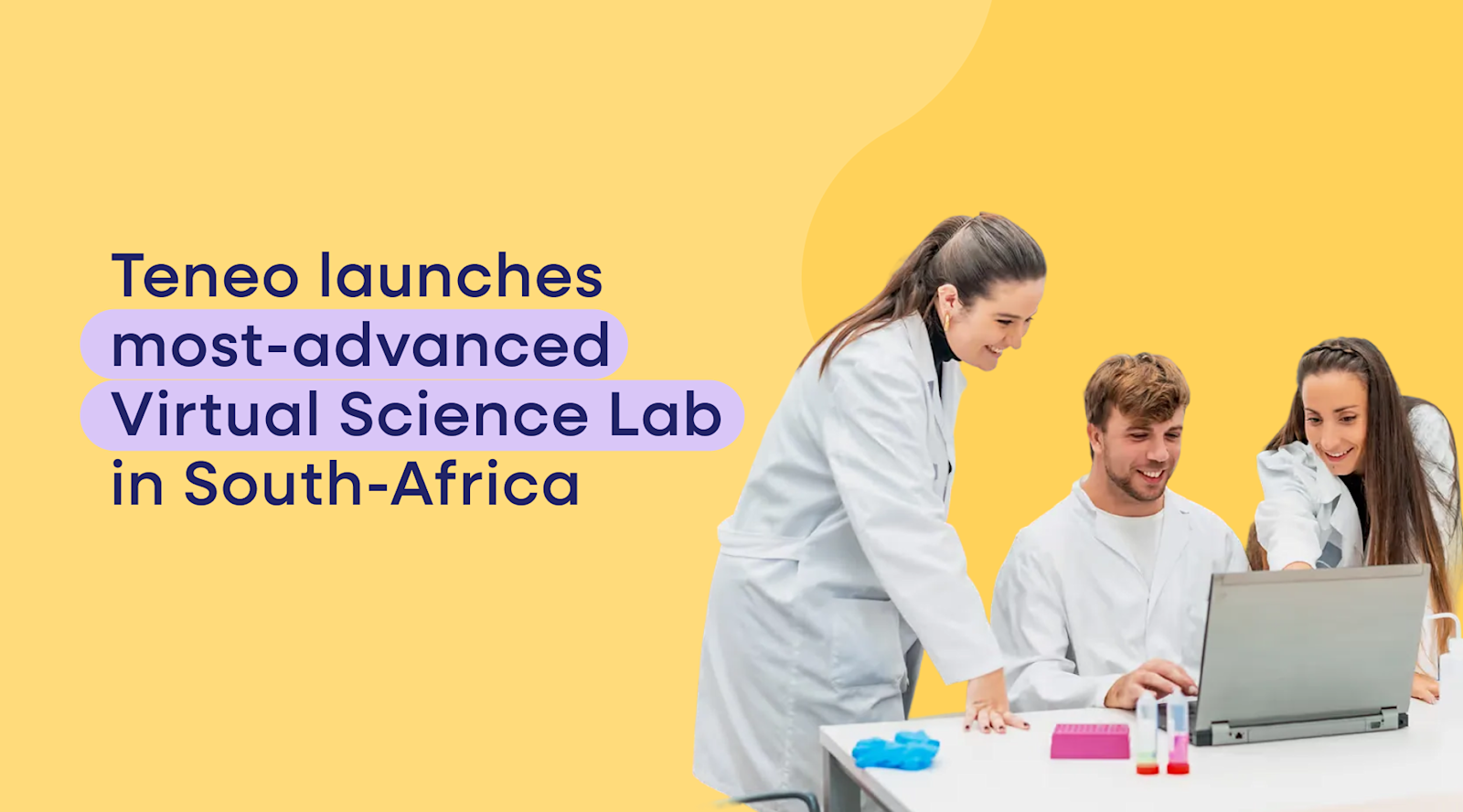
Making science accessible in South Africa: Teneo makes the most advanced ‘Million-Dollar’ virtual science lab to South African learners
We are so excited to announce that Teneo School has become the first school in South Africa to integrate Labster, the world’s most advanced virtual science laboratory! This is an incredible step forward that will offer learners unprecedented access to a "million-dollar" lab environment, allowing them to perform complex, high-cost, and more volatile experiments safely from home.
Traditionally, high-level STEM education is restricted by the cost of equipment and safety hazards. By adopting Labster, Teneo is democratizing science education in South Africa, replacing textbook theory with immersive, gamified simulations previously reserved for Ivy League universities and top-tier research facilities.
Gamifying the periodic table: A blend of Technology and Science
Inside the virtual environment, learners are guided by ‘Dr One,’ an AI mentor. Learners go into even more hands-on detail than one would get at an in-person school with immersive experiences, like stepping inside an animation of a cell, for example. Learners can truly witness protein synthesis or manage a nuclear reactor – scenarios that aren't possible in any other classroom.
“Many crucial experiments are too expensive, dangerous, or logistically impossible for traditional schools,” says Christine Meiring, Physical Sciences Subject Leader at . “We have removed those barriers. Our learners can now blow things up, mix volatile chemicals, and repeat experiments endlessly in a risk-free environment. The concept of using virtual environments to safely explore and experiment represents a foundational shift in science education. These activities allow learners to safely engage in chemical experiments that would otherwise be too risky. For example, learners can simulate rocket launches, test computer-driven robotics, or conduct forensic investigations by collecting and analyzing evidence. The platform also allows for exploration of scientific phenomena and concepts that would otherwise be inaccessible due to long distances or logistical constraints. Data and evidence collected from these virtual experiments can be used to assess understanding and improve educational outcomes. Technology provides tools and techniques that enhance the efficiency of engineering design and evaluation processes in education. It shifts science from memorisation to mastery.”
Why gamification in STEM?
Gamification – which means the integration of game-like elements into non-game settings, like a laboratory – has become a powerful tool in teaching science and technology. It transforms how learners and the public engage with complex conceptions.
In short: by turning learning into an interactive experience, gamification allows information and knowledge to become more accessible, memorable, and enjoyable for learners of all ages. Because when subjects are taught in a more hands-on, positive and fun manner, memory is improved and understanding skyrockets.
In the world of online education, gamified platforms allow learners to dive into biology, physics, and chemistry through immersive simulations and challenges. These experiences not only make abstract theories more tangible but they also foster curiosity and critical thinking – which are essential skills for everyone, especially those pursuing future science careers.
For example, learners might collect and analyze information in a virtual biology lab, or solve real-world physics problems through interactive scenarios, which is practice that helps improve both understanding and innovation.
Institutions like the Human Sciences Research Council (HSRC) have recognized the value of gamification in promoting scientific knowledge and technological innovation among South Africans. By encouraging participation in citizen science projects – such as tracking environmental impacts or helping out in large-scale research projects – gamification helps build a vibrant research network that encourages the development of new knowledge and ideas. These collaborative projects are then positively impacted by the quality assurance and applied research that gamified systems can provide – meaning the information collected becomes both more reliable and valuable.
Technological innovation continues to drive the evolution of gamification tools, with advances in artificial intelligence, virtual reality, and machine learning enabling even more engaging and effective educational experiences. These new technologies not only enhance learning but also allow for important advances in science and technology, by supporting the development of new processes, products, and solutions that can improve the world.
How gamifying the sciences can lead to a better world
The positive impact of gamification doesn't just stay inside classroom walls, or result in higher grades for learners. By making science and technology more appealing to young learners, it inspires future generations to understand and pursue further schooling into these industries – and it make science careers even more appealing.
Gamification also facilitates collaboration among scientists, scholars, and learners, strengthening the research network and supporting the creation of innovative projects that address real-world challenges, including environmental sustainability.
And the domino effect begins: More passionate, educated scientists result in industry growth, which then improves STEM developments, and thus, impacts the country’s economic development and gross domestic product.
Ultimately, the positive impacts of gamification in science and technologygr are expansive. It supports the growth of new knowledge, enhances the quality of learning, and empowers learners to become active contributors in society. By embracing gamification, schools like Teneo are not only improving academic outcomes but also preparing the next generation of innovators, researchers, and leaders who will shape the future of science, technology, and human life.
Student experience: “Like solving mysteries” in science careers
The integration transforms the learner experience from passive observation to active participation, with learners receiving training in scientific methods and critical thinking. Science is a diverse career path, extending from police investigations to studying the inner-workings of the universe. There are many professional fields and industries classified as "science", offering a wide range of opportunities.
In-demand science careers are determined by job growth percentage and the number of new jobs expected to appear in various fields.
Biology: DNA extraction and evolution simulation, with learners conducting hands-on experiments to discover biological processes, and study organisms and their environments.
Chemistry: Thermodynamics and organic chemistry, where learners conduct investigations to understand chemical reactions, and may develop new products or processes.
Physics: Quantum concepts and circuit building, allowing learners to conduct experiments and test scientific theories.
Engineering: Nanotech and robotics, with learners conducting design projects and simulating inventions. Robotics engineers use computers to design, prototype, and test automation solutions. R&D engineers design and improve products, and Biomedical engineers develop medical devices and equipment.
But it doesn't end there. There are plenty of other examples of science careers for Teneo learners who love the sciences:
Forensic science technicians - assisting on crime scene investigations, collecting and analysing evidence
Microbiologists - studying microscopic forms like viruses and can assist in vaccine creation
Research scientists - collecting samples, conducting experiments, creating proposals and hypotheses
Epidemiologists - Study disease patterns and public health
Many scientists and engineers are employed in research and development, contributing to innovation and technological advancement.
“It is way more interesting than just sitting in class taking notes,” says Karabo Agnes Mosia, a Grade 11 learner. “I felt like I was in a real lab, using real equipment and controlling everything myself.”
Learners are encouraged to make sense of scientific concepts through hands-on activities that connect theory to real-world applications. Learners also study the importance of collecting and analyzing evidence in their experiments, which is a key part of scientific investigations.
Classmate Jordan Sham notes the benefits of the ‘undo’ button in science: “I loved how I could repeat experiments to see different outcomes. The gamified elements and story-driven scenarios made learning feel more like solving mysteries than studying.” Assessment of experimental outcomes helps learners understand the scientific process and develop critical evaluation skills.
Discoveries in science inspire new ideas and inventions, showing how research findings can lead to technological advancements and practical solutions. The platform inspires new ideas and inventions by allowing students to experiment, innovate, and explore solutions to real-world challenges.
The scientific knowledge and data behind the tech
The investment in high-end EdTech aligns with Teneo’s data-driven approach to performance, providing strong support to learners through advanced technology and resources. Teneo is actively developing new processes and using computers and AI to track learner progress and provide personalised learning experiences.
The integration of AI and informatoin analytics in online schools helps identify weak spots and supports measurable academic outcomes. Learner performance data is used to inform teaching strategies and improve educational outcomes.
“Choosing a school is about giving children the tools to succeed,” adds Carina Botha, Life Sciences teacher. “At Teneo, they aren’t just memorising facts; they are thinking and innovating like true scientists.” Teneo’s approach contributes to the overall improvement of science education in South Africa. These outcomes are achieved through the combined effort of both learners and teachers, as well as the ongoing development of processes that enhance learning.
Join the Teneo universe
Teneo Online School is South Africa’s leading online private school, making a significant impact across the country by providing quality online schooling from Grade R to Matric across IEB and SACAI examination boards. Teneo offers accredited curricula from Grade R through Grade 12, including CAPS, IEB and SACAI, ensuring a wide range of options for families. The school delivers live, hybrid, and recorded lesson formats to accommodate different learning preferences – all facilitated by our 200 qualified, SACE-registered teachers.
Our proven academic results and world-class Smart School System allows us to support every learner's learning style, and prioritise thier health, security and wellbeing. As a result, we have helped more than 3 500 learners matriculate with a National Senior Certificate (NSC), opening the doors to tertiary schooling and future career opportunities with employers in the science and technology fields, and beyond.
Our award-winning Smart School System™ combines the best parts of in-person schooling, with the convenience and benefits of online learning, while providing training and development opportunities to students. Teneo is committed to excellence and building student capabilities, ensuring every learner benefits from a robust educational foundation. We facilitate access to technological innovation for all South Africans, supporting learners across South Africa. If you’re ready to take the next step towards education of the future, start your learning journey with Teneo today.